| dc.contributor.author | Alemdar, Muaz | |
| dc.date.accessioned | 2025-12-16T07:10:47Z | |
| dc.date.available | 2025-12-16T07:10:47Z | |
| dc.date.issued | 2025 | en_US |
| dc.identifier.uri | https://hdl.handle.net/20.500.12723/4418 | |
| dc.description.abstract | Bu çalışma, Roderick Chisholm'un isnat (İng. attribution) kavramını temel alarak geliştirdiği nesnel gönderim kuramını analitik dil felsefesi ve dil evrimi bağlamında incelemektedir. Quine'ın doğallaştırılmış anlambilimine (İng. naturalized semantics) karşın Chisholm, gönderimin temelinde dilsel olmayan, yönelimsel bir eylem olan isnadın bulunduğunu savunur. Quine için dilsel gönderim kamusal alanda edinilen ve davranışsal bir eylem iken Chisholm gönderimi Ben'in yönelimi üzerinden temellendirir. İsnat, öznenin bir özelliği doğrudan kendisine veya teşhis bağıntısı (İng. identifying relation) aracılığıyla dolaylı olarak başkalarına atfetmesidir. Ben, Bu ya da Sen gibi adıllar ve özel adlar, bu iki farklı isnat türünün farklı aşamalarının dilsel karşılıklarıdır. Tezin son bölümü, Chisholm'un nesnel gönderim kuramını dil evrimi tartışmalarına uygular ve ilksel dilin bağlama sıkıca bağlı basit bir iletişim dizgesi olmasından ziyade Ben'in öncelikliliğini ve gönderimsel esneklik ile başladığını öne sürer.
-----
This study examines Roderick Chisholm's theory of reference, developed based on the concept of attribution, within the context of analytic philosophy of language and language evolution. In contrast to Quine's naturalized semantics, Chisholm argues that attribution, a non-linguistic, intentional act, lies at the foundation of reference. While for Quine linguistic reference is a socially-acquired behavioral act , Chisholm grounds reference in the subject's intentionality. Attribution is the act of the subject directly ascribing a property to itself or indirectly to others through an identifying relation. Pronouns such as I, This, or You, and proper names are the linguistic counterparts of these two different stages of attribution. The final section of the thesis applies Chisholm's theory of objective reference to discussions of language evolution and argues that rather than being a simple communication system tightly bound to context, the original language began with the primacy of I and displacement. | en_US |
| dc.language.iso | tur | en_US |
| dc.rights | info:eu-repo/semantics/openAccess | en_US |
| dc.subject | İsnat, Teşhis Bağıntısı, De Se İnanç, Dil Evrimi, Roderick Chisholm, Orman Quine - Attribution, Identifying Relation, Belief De Se, Language Evolution, Roderick Chisholm, Orman Quine | en_US |
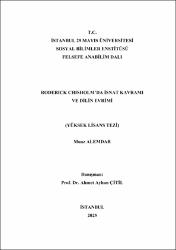
| dc.title | Roderick Chisholm'da isnat kavramı ve dilin evrimi | en_US |
| dc.type | masterThesis | en_US |
| dc.department | 29 Mayıs Üniversitesi, Sosyal Bilimler Enstitüsü, Felsefe ve Din Bilimleri Programı | en_US |
| dc.identifier.endpage | XI, 94 s. ; 30 cm. | en_US |
| dc.relation.publicationcategory | Tez | en_US |