| dc.contributor.author | Büyükçolpan, Seçil | |
| dc.date.accessioned | 2025-12-22T13:08:52Z | |
| dc.date.available | 2025-12-22T13:08:52Z | |
| dc.date.issued | 2023 | en_US |
| dc.identifier.uri | https://hdl.handle.net/20.500.12723/4518 | |
| dc.description.abstract | Bu çalışma Slovenya ve Hırvatistan'ın Avrupa Birliği'ne katılım süreçlerinin farklı ilerlemesinin nedenlerini Yugoslavya Federasyonu'nda yaşadıkları geçmiş olaylarla incelemektedir. Yugoslavya'nın çöküşünün arkasında belirli sebepler vardı. Bunlardan biri Josip Broz Tito'nun ölümünden sonra devletlerde milliyetçiliğin artmasıydı. Çalışmada bir diğer neden olarak Avrupa Topluluğu'nun etkisi de incelendi. Bağımsızlık hareketleri sırasında, Orta ve Doğu Avrupa ülkelerinin çoğu "Avrupa'ya dönüşü" bir retorik araç olarak kullandı. Bu bağlamda Slovenya ve Hırvatistan'ı diğer eski Yugoslavya ülkelerinden ayıran özellik, Avrupa Birliği'ne katılabilen yegâne ülkeler haline gelmeleridir. Ancak Slovenya 2004 yılında, Hırvatistan ise 2013 yılında katılabildi. 1991 yılında Yugoslavya'dan bağımsızlıkları aynı olsa da sonraki süreç farklı gelişti. Bu çalışma, Yugoslavya'nın geçmişinden kalan mirası inceleyerek bu zaman farkının nedenlerini tespit etmeye çalışmaktadır. Ancak sonuçlar, nedenlerin geçmişle sınırlı kalmadığını, Avrupa Birliği'nin genişleme kaygılarının da arttığını ortaya koyuyor.
-----
This study analyses the reasons for the different progress of Slovenia and Croatia during the European Union accession processes with the past events they lived in the Yugoslavia Federation. Behind the collapse of Yugoslavia, there were particular motives. One of them was the increase of nationalism in the states after the death of Josip Broz Tito. The study also examined the impact of the European Community as another reason. During the independence movements, most of the Central and Eastern European countries used "return to Europe" as a rhetorical device. In this context, what distinguishes Slovenia and Croatia from other former Yugoslavian countries is that they have become the only countries that joined the European Union. However, Slovenia joined in 2004, while Croatia could join in 2013. Although their independence from Yugoslavia in 1991 was the same, the following process developed differently. This study attempts to ascertain the reasons for this time difference by analysing the legacy of Yugoslavia's past. However, the results reveal that the reasons are unrestricted to their past but also the European Union's evolving enlargement concerns. | en_US |
| dc.language.iso | eng | en_US |
| dc.rights | info:eu-repo/semantics/openAccess | en_US |
| dc.subject | European Union (EU), Yugoslavia, Slovenia, Croatia, Nationalism - Avrupa Birliği, Yugoslavya, Slovenya, Hırvatistan, Milliyetçilik | en_US |
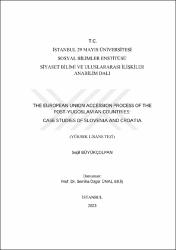
| dc.title | The European Union accession process of the Post-Yugoslavian countries : case studies of Slovenia and Croatia | en_US |
| dc.type | masterThesis | en_US |
| dc.department | 29 Mayıs Üniversitesi, Sosyal Bilimler Enstitüsü, Siyaset Bilimi ve Uluslararası İlişkiler Programı | en_US |
| dc.identifier.endpage | XIII, 102 s. ; 30 cm. | en_US |
| dc.relation.publicationcategory | Tez | en_US |